Brendan Lynskey

Curriculum vitae

Brendan Lynskey

Experienced engineer working in AI systems (LLMs, agents, MCP, Python) with a background in FPGA, DSP, hardware and power.

Profile

Engineer with over 25 years' experience across hardware, FPGA, SoC, DSP and software. Much of it designing and verifying FPGA and SoC systems (packet switching, high-speed serial links, cable modem PHY/MAC, CPU debug, broadcast video, cryptography), then board-level hardware for AI accelerators at Blaize: power delivery, signal integrity and DDR. For the last two years almost entirely software, mainly Python, building agentic AI systems with LangGraph and MCP; Claude Code and OpenCode every day. Keen to work where a hardware background counts, such as new compute architectures.

Timeline

Career timeline from 1994 to now: one band per role, coloured by domain, with study below. The same information is in the list under “The timeline as text” and in Experience.

  • Hardware
  • FPGA and SoC
  • DSP
  • Cryptography
  • Software and AI
  • Study
The timeline as text
  1. July 1994 – August 1997: Hardware Engineer, Thales (Hardware + FPGA and SoC)
  2. October 1998 – June 2002: Engineer, Pace (Hardware + FPGA and SoC)
  3. June 2002 – July 2005: Senior Engineer, Comodo (FPGA and SoC + Cryptography)
  4. July 2005 – June 2011: Principal Engineer, Pace (FPGA and SoC + DSP)
  5. May 2011 – September 2014: Senior Consultant, Red Embedded (FPGA and SoC + Hardware + DSP)
  6. September 2014 – July 2018: Senior Design Engineer, Imagination Technologies / MIPS (FPGA and SoC + Hardware + DSP)
  7. July 2018 – present: Staff Engineer, Blaize (formerly Thinci) (Hardware + Software and AI)
  8. 2003–2008: MSc Low Power Systems Integration, University of Manchester
  9. 2010–2013: Diploma in Mathematics, The Open University
  10. 1997–1998: MSc Music Technology (DSP), University of York

Experience

July 2018 – present

Staff Engineer · Blaize (formerly Thinci)

LeedsHardwareSoftware and AI

Blaize makes energy-efficient SoCs for machine learning and computer vision. Dual role: software/AI engineering and hardware systems engineering.

  • Building an agentic analytics system in Python with LangGraph, MCP, vLLM and Qwen models on DGX Spark, including automated evaluation regression-test suites; video analytics; accelerated development using Claude.
  • Responsible for the System-on-Module that won the 2022 Edge AI and Vision Product of the Year award and a 2022 Sacramento Business Journal Innovation Award, plus its commercial and industrial variants.
  • Power delivery (multiphase DC-DC, PoE, flyback), SI/PI and thermal for PCIe accelerator cards and modules with PCIe Gen3, USB 3.0, MIPI and LPDDR4, from concept through layout (HDI), bring-up, environmental test, conformal coating and EMC pre-compliance.
  • Simulated and measured power networks, high-speed serial links and DDR interfaces in the time and frequency domains (Cadence Sigrity tools, 3D extraction). Reviewed SoC FC-BGA substrates.
  • Analysed SoC SystemVerilog as part of system debug; built a Zynq UltraScale+ MPSoC prototype (PetaLinux); analysed competitor systems; ML development and benchmarking in Python.
  • Tooling: a Python utility that derives PI requirements from raw power-simulation data using STFT analysis; PowerShell/SKILL release tools for Cadence; VS Code extensions in TypeScript.
  • EDA: Cadence suite (DE, Allegro, PowerSI, SystemSI, PowerDC, OptimizePI), LTspice/LTpowerCAD II, SIMetrix/SIMPLIS.
September 2014 – July 2018

Senior Design Engineer · Imagination Technologies / MIPS

LeedsFPGA and SoCHardwareDSP

Debug and probes team.

  • High-performance CPU debug systems on Xilinx 7 Series: AXI, PCIe bus mastering, DDR3, Aurora, XADC analogue capture, embedded Linux (U-Boot, Buildroot).
  • FPGA prototyping platforms for IP cores on UltraScale and AWS EC2 F1 (UltraScale+), covering the whole stack from RTL to Linux device driver.
  • On-chip instrumentation cores, and software transactors that drove RTL simulation and emulation over TCP/IP (Verilog/C VPI PCIe transactors).

May 2011 – September 2014

Senior Consultant · Red Embedded

SaltaireFPGA and SoCHardwareDSP

Consultancy across hardware, FPGA and software.

  • FPGA broadcast product using Xilinx video IP (3G-SDI, scaler), AXI and embedded Linux (VHDL, C).
  • Two FPGA DSP projects with Sagentia, for geophysics and medical applications (Verilog, VHDL, System Generator).
  • High-performance PC-based DSP (video processing) for professional broadcast (Python, C++); automated RF testing for powerline comms (Python).

July 2005 – June 2011

Principal Engineer · Pace

SaltaireFPGA and SoCDSP

Delivered complete FPGA systems for cable headend and transmodulator products.

  • High-performance packet classifiers and switches, with DDR interfaces, an on-chip bus and large FIFO structures.
  • DOCSIS QPSK/16-QAM burst receiver and J.83 64/256-QAM modulator PHY and MAC layers; Gigabit Ethernet; high-speed inter-FPGA links; embedded MicroBlaze/PowerPC systems; clock-domain crossings.
  • Overhauled the group's verification strategy.
  • Also a CableCARD (M-Card) interface and a BER instrument for satellite receivers.

June 2002 – July 2005

Senior Engineer · Comodo

BradfordFPGA and SoCCryptography

Front-end design of a 0.18 µm cryptographic SoC (TPM / security token). Designed and integrated an in-house crypto processor (RSA, SHA-1, 3DES, AES, PRNG) with an 8051 CPU, USB, smartcard and LPC interfaces.

October 1998 – June 2002

Engineer · Pace

SaltaireHardwareFPGA and SoC

Built Pace's first hard-disk MPEG-2 prototype (PCB, FPGA) and FPGA blocks (DVB, UDMA-66) for a 3DES-protected PVR, which won the company's Most Inspiring Invention award in 2000. Also an ADSL–HPNA set-top-box bridge, and an IrDA handset for speech/speaker recognition.

July 1994 – August 1997

Hardware Engineer · Thales

StockportHardwareFPGA and SoC

Designed the Sonar 2076 data transceiver (1 Gbit/s fibre optics, ECL serial datapath, Fibre Channel, SHARC processors); worked on a DSP co-processor ASIC.

Selected public work

Showcase

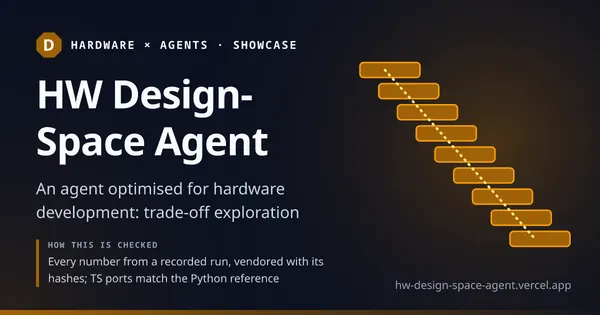
HW Design-Space Agent

A LangGraph agent that explores hardware design trade-offs from one spec down a fidelity ladder to synthesis, with every number from a recorded run.

hw-design-space-agent.vercel.app

How it runs, one forward pass

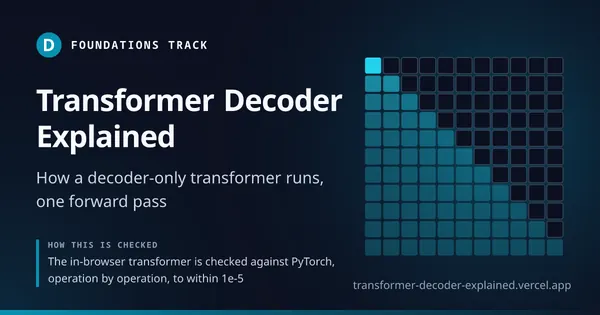
Transformer Decoder Explained

The TypeScript transformer in your browser is checked against PyTorch, operation by operation, to within 1e-5, and the animations' frames against a float64 PyTorch run of the same seeded weights.

transformer-decoder-explained.vercel.app

Hardware deck series

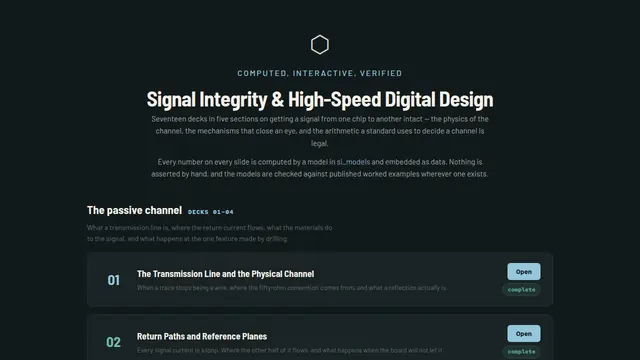
Signal Integrity & High-Speed Digital Design

Getting a signal from one chip to another intact: transmission lines, return paths, materials, vias, crosstalk, jitter, power integrity, timing budgets, de-embedding and channel operating margin. Every number is computed by a model and checked against published worked examples.

brendanjameslynskey.github.io/Signal_Integrity

Inside a matrix engine

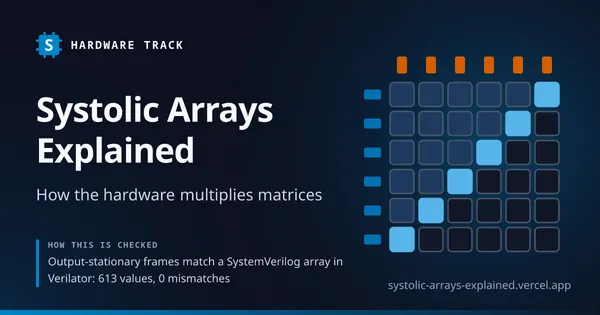
Systolic Arrays Explained

The cycle-accurate model's output-stationary frames match a SystemVerilog array simulated in Verilator 5.020 on every accumulator after every clock edge: 613 values, 0 mismatches.

systolic-arrays-explained.vercel.app

Graphs, multi-agent patterns, durability

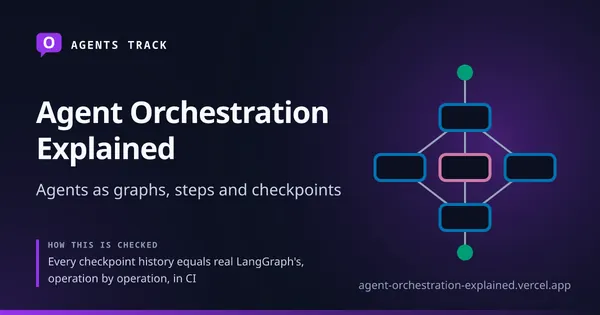
Agent Orchestration Explained

Each of 39 sessions also runs in real LangGraph 1.2.14, and after every one of 71 operations its whole checkpoint history equals the engine's.

agent-orchestration-explained.vercel.app

Hardware deck series

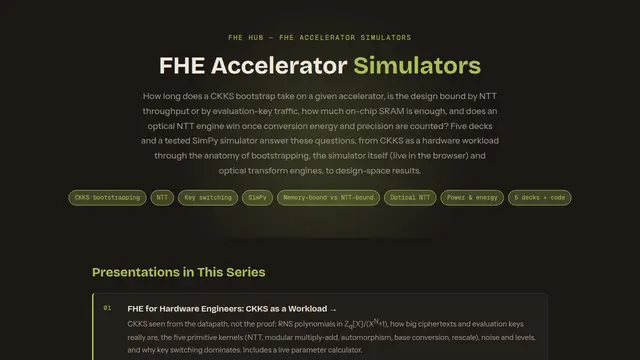
FHE Accelerator Simulators

Simulating a fully homomorphic encryption accelerator running CKKS bootstrapping: the workload, the anatomy of bootstrapping, a SimPy accelerator model with a live in-browser simulator, optical NTT engines and the design space.

brendanjameslynskey.github.io/FHE_Hub_Accelerator_Simulators

Education

  • 2003–2008MSc Low Power Systems Integration, University of Manchester (part-time)
  • 2010–2013Diploma in Mathematics, The Open University (part-time)
  • 1997–1998MSc Music Technology (DSP), University of York
  • 1991–1994BEng (Hons) Electronic Engineering, University of Manchester

Certifications

  • Xilinx Certified Engineer
  • Accelerated Computer Science Fundamentals Specialization
  • Digital Signal Processing Specialization (and others in DSP)
  • AI Engineer Core Track: LLM Engineering, RAG, QLoRA, Agents
  • MCP Crash Course: Complete Model Context Protocol (and others in AI and MCP)
  • Cadence: SiP Layout v17.2 exam; Celsius Thermal Solver v2021 exam (and others)

Selected; full list on LinkedIn.